Do you know what's in the water at the last house on the line?
Most utilities measure chlorine at the plant. Thirty kilometres later, nobody knows. And the first sign of trouble is usually the phone ringing.
EU Drinking Water Directive 2020/2184 Compliance is now measured at the tap, not at the plant.
Friday's result for Tuesday's water.
01
Blind between samples
You measure chlorine at the plant and take a sample at the far end once a week. Between those two points and those seven days, nobody knows what the water is doing. If the residual drops on Tuesday night, you find out on Friday. Or from a customer.
Daily grab sampling catches only 60 to 70 % of residual drops that last less than a day.
02
One low reading. One boil-water notice.
Chlorine fades as water travels: long pipes, dead ends, a warm reservoir in summer. When one point in the network falls below the minimum, the rule is simple: tell everyone to boil their water. Not because anything was found, but because you cannot prove the water was protected everywhere.
WHO guideline: at least 0.2 mg/l free chlorine at the point of delivery. One reading below it can be enough for a precautionary notice.
03
Overdosing the first house to protect the last one
The only way to keep chlorine at the last house is to add more at the plant. So the first houses get water that smells of chlorine, by-products rise, and you pay for the chemical twice: once to add it, once to deal with the complaints.
Higher chlorine at the plant means more trihalomethanes near it and more taste and odour complaints.
04
More kilometres, fewer operators
Every sample is a drive: to the reservoir, to the far village, back to the lab. Your most experienced people spend their days in the van. And every analyser you add to save them a trip brings its own: reagents to change, water to drain, a service visit every month.
71 % of utilities name staffing as a barrier to day-to-day operations.
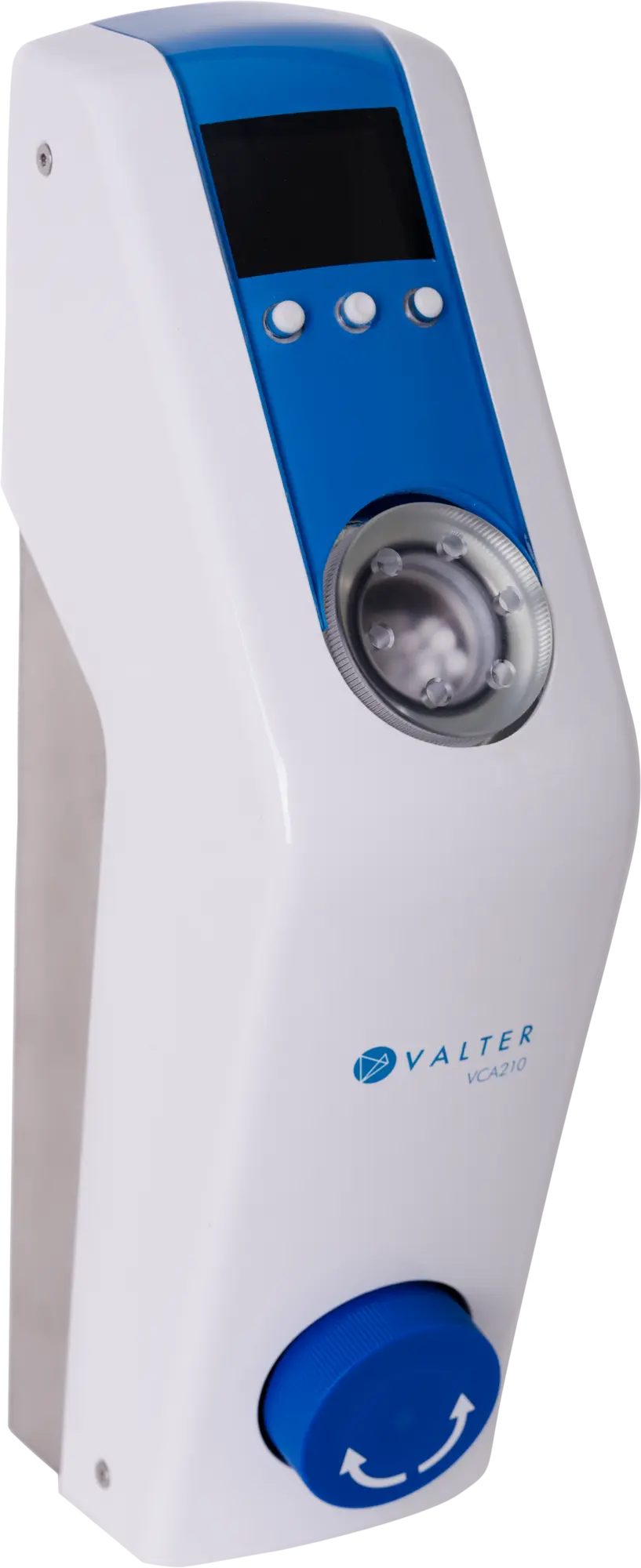
C210 sits directly in the pressurised line and keeps every litre in the pipe. Hover or tap a point to take a closer look.
1Self-cleaning cell. One service a year.
Glass beads polish the gold and copper electrode on every pass, so the reading stays stable with nobody on site. Once a year you pull the built-in key, open the window and swap the beads. About an hour, about €25, no reagents ever.
Click or tap to see it
2Zero sample water lost. Measures under line pressure.
The C210 measures inside the pressurised line, up to 16 bar, and returns every litre to the pipe. No drain, no sample loop, no conditioning panel. Around 350,000 litres a year stay in your network, per analyser.
Click or tap to see it
3A reading every 30 seconds. Or as often as you set.
The C210 measures on its own, every 30 seconds by default. The interval is yours to set: short where the water changes fast, longer where power is scarce. The display counts down to the next reading, so you always know how fresh the number is.
Click or tap to see it
4Calibration in under 10 seconds
Zero is fixed at the factory. You take a DPD reading, adjust one point on the display, done. In practice up to 6 months between calibrations, and the C210 holds the reading in between.
Click or tap to see it
5Connects to anything. Can act alone.
4–20 mA and Modbus RS-485 at the same time, alarm outputs for high and low chlorine, and direct control of a dosing pump. Runs on 9 to 36 V and under 100 mA: mains, battery or a small solar panel.
Click or tap to see it
Installed in an hour: mounting plate, two hoses, power. Pre-set at the factory, one calibration after 24 hours.
live free-chlorine reading at every point of the network, not one weekly sample
0
between readings by default, adjustable to the point
0
a year: about an hour, about €25, no reagents
0
calibration: one point, one person, no specialist
350,000 l of water saved per analyser, per yearUnder 100 mA at 9 to 36 VUp to 16 bar in the line20-year design life
From one point to the whole network
One network. Every point visible.
Where you put a C210 decides what you can see. Hover or tap a point on the map to see how it is installed there.
1In the plant
2In the reservoir
3On the pipeline
4In a valve chamber
5At the last house
6Mobile, wherever needed
In the plant
Wall-mounted next to the dosing system. The C210 closes the loop and can drive the dosing pump directly, with no separate controller.
One cabinet collects them all. Every point reports over Modbus or 4–20 mA to one control cabinet, which passes the whole network on to your SCADA. One screen, every point, the same number you would get at the tap.
The operator's checklist
Nine things operators ask for. Nine honest answers.
We asked what utilities praise in an analyser and what they wish it did. This is where the C210 stands.
Runs for months without a visit
One service a year: about an hour and roughly €25 in parts. Pull the built-in key, open the window, change the cleaning beads. 1.3 g of gold and a massive copper electrode mean there is almost nothing to wear out.
No reagents
Nothing to stock, order or dispose of. No reagent pumps, no tubing, no monthly change.
No drain, no wasted water
Every litre returns to the pipe under line pressure, up to 16 bar, via the built-in return pump or a pressure drop. Around 350,000 litres a year stay in the network, per analyser.
Installed in an hour, pre-set at the factory
Mounting plate on the wall, hook the analyser on, connect two hoses and power. One calibration after 24 hours and it runs.
Calibration you can do yourself
Zero is fixed at the factory. You adjust one point to your DPD reading in under 10 seconds. In practice up to 6 months between calibrations, depending on your water.
Holds the reading between calibrations
Temperature-compensated. No pH sensor, by design: the large gold and copper electrode gives a signal strong enough that pH has far less influence than on conventional amperometric cells. In utility water with stable pH, the reading holds. For waters with pH swings, a pressure-rated pH sensor with automatic compensation is in development.
Works where there is no power
Under 100 mA at 9 to 36 V: mains, a LiFePO4 battery or a small solar panel. Intermittent operation possible. With the return pump, 150 to 200 mA.
Talks to your system, or acts alone
4–20 mA and Modbus RS-485 at the same time, alarm outputs for high and low chlorine, and direct control of a dosing pump: a small controller where you have none.
Certificates and approvals
Drinking-water safety permit NNGYK/58212-2/2024 from Hungary's National Center for Public Health and Pharmacy: approved for drinking-water supply, no public-health restrictions. CE declaration of conformity. Verified against the DPD reference method (EN ISO 7393).
Compare
What a year of ownership looks like.
Typical values from manufacturers' published maintenance schedules. Your water will move them a little; the pattern stays the same.
AQUENIX C210
DPD colorimetric analysers
Membrane amperometric analysers
Service interval
Once a year
Monthly: reagents, tubing, cell cleaning
Every 2 to 8 weeks: membrane, electrolyte
Service time and parts
About 1 hour, about €25
Monthly visit, reagent and tubing kit
Membrane and electrolyte kits, polishing
Reagents
None
Buffer and indicator, replaced monthly
None (electrolyte refill)
Sample water to drain
None, returns to the pipe
Continuous, to drain
Continuous, to drain
Works under line pressure
Yes, up to 16 bar
No, needs bypass and drain
Usually no
Power
9 to 36 V, under 100 mA
Mains
Mains
Reading interval
Every 30 s, adjustable
One reading every 2 to 3 min (reagent cycle)
Continuous signal, controller response typically 1 to 3 min
Calibration
One point, under 10 s, up to 6 months apart
Reagent change monthly, cell cleaning
Weekly check typical
Outputs
4–20 mA + Modbus RS-485 + alarms + pump control
4–20 mA, options extra
4–20 mA, options extra
Measuring electrode
1.3 g gold, massive copper
Optical cell
Thin electrode behind a membrane
Points you can afford per network
Many: one cabinet collects them all
Usually one, at the plant
One or two
Competitor columns summarise published schedules of typical products (monthly reagent and tubing changes for DPD analysers; membrane and electrolyte changes every 6 to 12 months plus frequent calibration checks for membrane sensors). No brand is named; check your own analyser's manual.
Proof
Proven on a live network. Črnomelj, Slovenia.
Three years, one utility, 528 km of pipe. The C210 is the measuring layer of Aquamind, the real-time water-quality platform built with Komunala Črnomelj.
The smart drinking fountain in Črnomelj shows the live chlorine reading on the street.Measuring chamber on the network: C210, return pump, 12.8 V battery.
7 → 20
free-chlorine analysers on one network, before and after the pilot
528 km
of water network, from the Dobliče source to the last village
18,000
people supplied, every point reporting every 30 seconds
What changed for the operator
The state of the whole network at any moment, not on the next sampling round.
Fewer kilometres driven to take samples.
Dosing adjusted to the residual actually measured in the network, so less disinfectant.
An alarm the moment a point drifts, with location and severity.
Microbiology results on site in about 8 hours instead of 36 to 48 hours from an outside lab.
Project PD-VCA210, 2023 to 2026, a pilot-demonstration project under Slovenia's Recovery and Resilience Plan. Lead partner Valter skupina; partners Infotim Ržišnik Perc, Microbium and Ekstera; end user JP Komunala Črnomelj. Results as presented by Komunala Črnomelj at the closing event, 25 February 2026.
Winner of the BABLE Urban Shark Tank: voted by the audience as the most replicable urban innovation at Europe's largest event for city change-makers.
2026
Smart Communities and Mobility, Finance
1st place, digital and technological solutions for smart communities, at the 4th conference organised by Časnik Finance with the GZS Engineering Association, the Jožef Stefan Institute and the Urban Planning Institute of Slovenia.
2026
GZS Innovation Challenge
Special national recognition from the Chamber of Commerce and Industry of Slovenia: the one award given for the innovation that best answers a defined national challenge.
All three as part of the Aquamind consortium: Valter skupina, Infotim Ržišnik Perc, Microbium, Ekstera, with JP Komunala Črnomelj.
Paperwork that checks out
Drinking-water safety permit, Hungary (NNGYK/58212-2/2024)CE declaration of conformityVerified against the DPD reference method (EN ISO 7393)List of wetted materials
Documents available on request with your pilot or partner enquiry.
Pilot and partners
Start with one point. Grow at your pace.
Two ways to work with us: run the C210 in your own network, or bring it to the utilities in your country.
For water utilities
Request a pilot
1
Demo call, 30 minutes. We walk through your network together and pick the point where a live reading would change the most: a far reservoir, a dead end, the last village.
2
Pilot installation. We install and commission the first C210 in your system, on pilot terms, and run it next to your existing sampling so you can compare the numbers yourself.
3
Rollout, point by point. Add points at your pace. One cabinet collects them all and passes the whole network on to your SCADA.